A gallery wall succeeds or fails on millimeters. The art can be beautiful and the frames expensive, but if the gaps wander and the group sits too high, the whole wall reads as an accident. The good news: gallery wall spacing follows a small set of formulas used by professional installers, and once you know them — the gap rule, the center-height rule and the furniture rules — you can lay out any wall, over any sofa or staircase, and get it right the first time, with painter’s tape instead of a wall full of wrong holes. Here is the complete gallery wall spacing formula, explained simply.
The Core Formula: Gaps, Height and Grouping
Rule 1 — The gap: 2 to 3 inches, everywhere
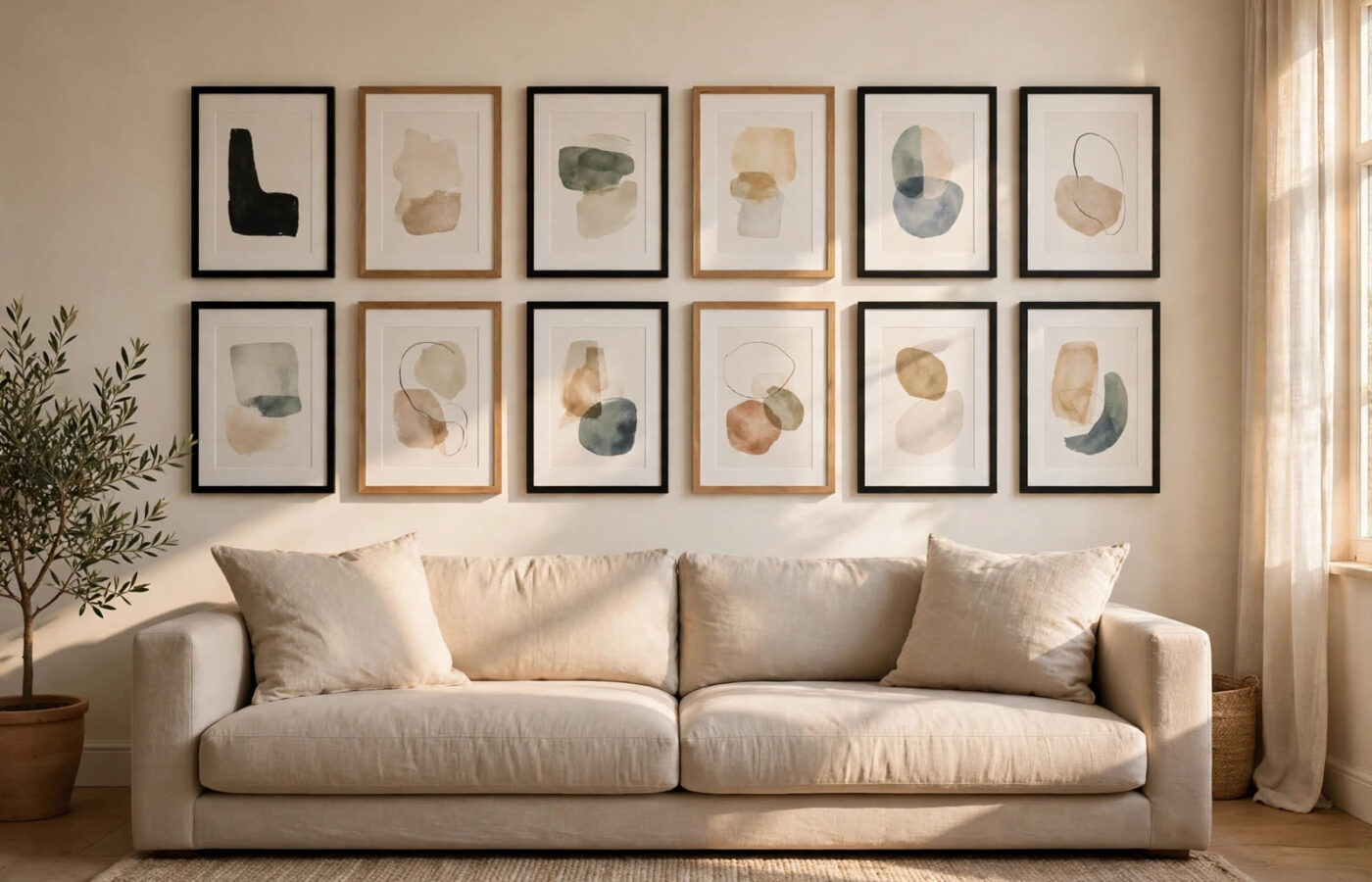
Keep the space between frames consistent at 2–3 inches (5–7.5 cm) in every direction — horizontal, vertical and diagonal. In small rooms or with small frames, use 2 inches; with large frames or high ceilings, 3 inches breathes better. Consistency matters more than the exact number: a wall with every gap at 2.5 inches looks deliberate, while a wall mixing 1-inch and 5-inch gaps looks improvised, even with identical art.
Rule 2 — The center height: 57 to 60 inches
Hang the center of the whole arrangement — not the center of each frame — at 57–60 inches (145–152 cm) from the floor, roughly average eye level. This is the gallery standard used by museums. Most home walls are hung 6–10 inches too high, which disconnects the art from the furniture below it. Treat the group as one big artwork: find its total height, halve it, and place that midpoint at 57–60 inches.
Rule 3 — The group width: two-thirds of the furniture
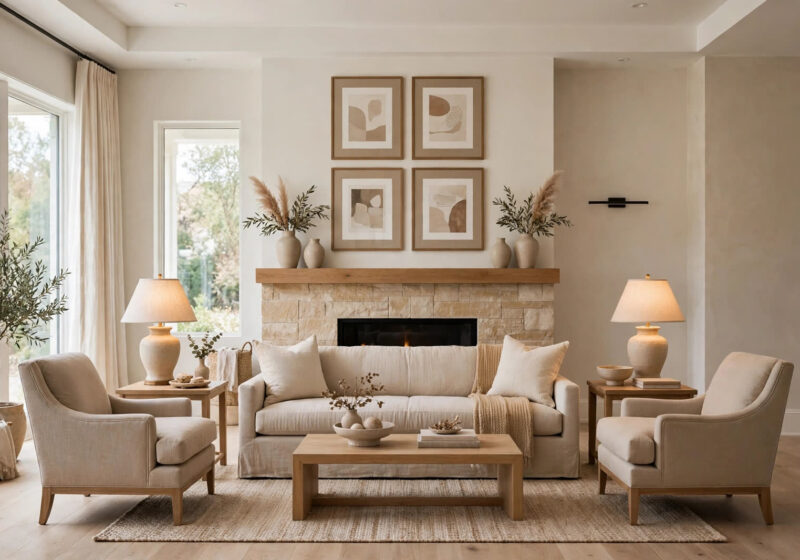
Over a sofa, console or bed, the arrangement should span about two-thirds of the furniture’s width and sit 6–10 inches above its back. Narrower looks lost; wider looks top-heavy. A 84-inch sofa wants a gallery roughly 56 inches wide, centered on the sofa — not on the wall.
Gallery Wall Spacing Over a Sofa: Step by Step
- Measure the sofa width; multiply by 0.66 for your target group width.
- Lay every frame on the floor inside that width, keeping 2–3 inch gaps, largest piece slightly off-center.
- Measure the group’s total height; mark the wall so the group’s center lands at 57–60 inches, checking the bottom edge stays 6–10 inches above the sofa back.
- Trace each frame on kraft paper, tape the papers to the wall with the same spacing, and live with it for a day.
- Mark nail points through the paper, remove, drill, hang.
Staircase Gallery Walls
Stairs scare people, but the formula is friendly: keep the bottom edge of the arrangement following the slope of the handrail, roughly 36 inches above each step’s tread line, and maintain the same 2–3 inch gaps. Work in diagonal groups of three to five frames per flight section, stepping the group’s center up with the stairs. Start from the middle step and build outward — never from the bottom, or you will run out of wall at the top.
Layouts That Always Work
- The grid: identical frames, identical gaps (2 inches), perfect rows. Best with matching photos or prints — the most forgiving layout for beginners.
- The salon: mixed sizes built around one large anchor piece placed slightly off-center, gaps locked at 2–3 inches. Organic but disciplined.
- The ledge: picture shelves with frames leaning and overlapping. Zero spacing math, easy to change — ideal for renters.
- The column: a vertical stack in a narrow wall section, center line aligned, 2-inch gaps. Perfect for hallways and beside doors.
Frame and Mat Tricks That Fix Spacing
If frames are different sizes, unify them with the same frame finish and generous white mats — the eye reads the mat as breathing room, which forgives small spacing variations. Keep at least one consistent element across the whole wall: frame color, mat width or a shared color in the art itself. And mix orientation deliberately: an all-portrait wall feels stiff; roughly two-thirds portrait to one-third landscape is a reliable ratio.
Common Gallery Wall Spacing Mistakes
- Hanging too high. The number one error. If you can see more wall between art and furniture than within the art, it is too high.
- Spacing by feel. Eyeballing gaps guarantees drift by the fifth frame. Measure, or use a 2.5-inch spacer block of wood as a physical guide.
- Spreading to fill the wall. A tight, confident group on part of a wall beats frames scattered edge to edge.
- Centering on the wall instead of the furniture. Art belongs to the seating group below it, not to the architecture.
FAQ
How far apart should gallery wall frames be?
2–3 inches between every pair of frames, kept consistent across the whole arrangement. Use 2 inches for small frames and compact walls, 3 inches for large frames and tall ceilings.
At what height should a gallery wall hang?
The center of the whole group at 57–60 inches from the floor. Over furniture, also keep the group’s bottom edge 6–10 inches above the furniture’s back.
How wide should a gallery wall be over a sofa?
About two-thirds of the sofa’s width, centered on the sofa. For an 84-inch sofa, aim for a group near 56 inches wide.
Should gallery wall frames match?
They do not need to be identical, but one unifying element — same finish, same mat style or a shared palette — keeps mixed frames looking curated rather than collected by accident.
Conclusion
Gallery wall spacing is not talent; it is three numbers — 2–3 inch gaps, a 57–60 inch center, and two-thirds of the furniture width — applied with tape before nails. Master the formula and any wall in the house becomes a weekend project with a professional result. For more measured design rules like this, browse our room guides from the homepage and plan your next wall with confidence.